
1. What Is a Jaw Crusher?
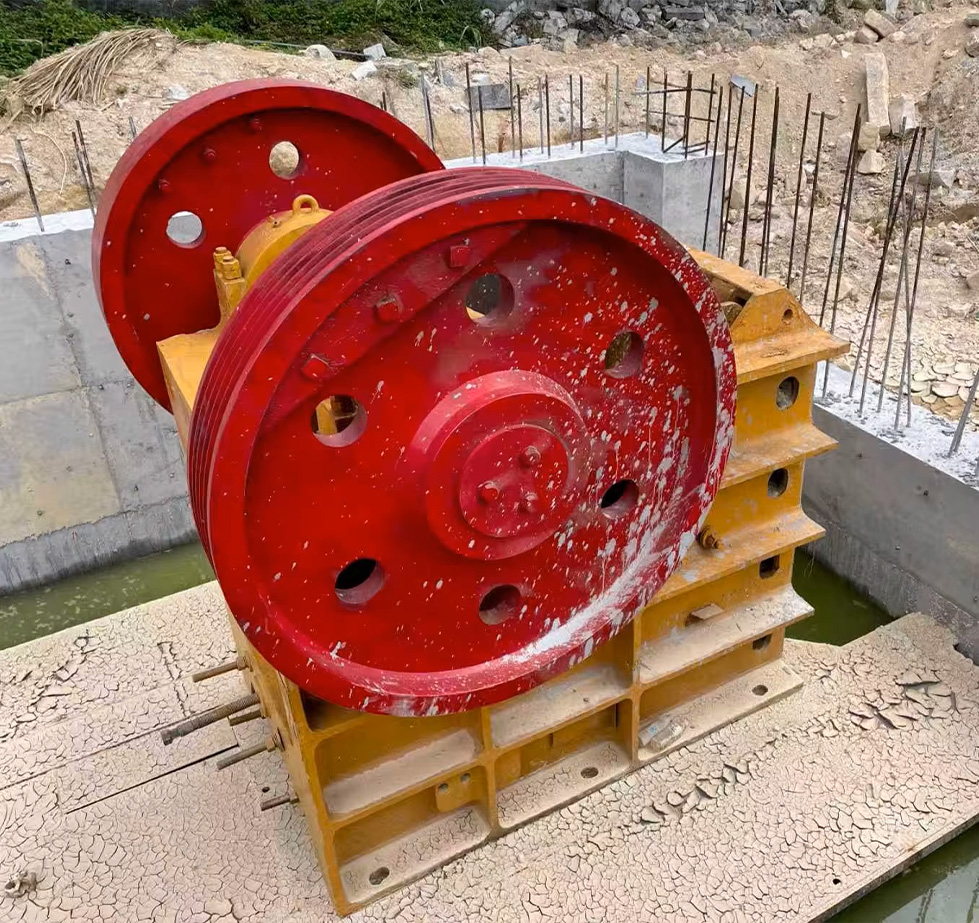
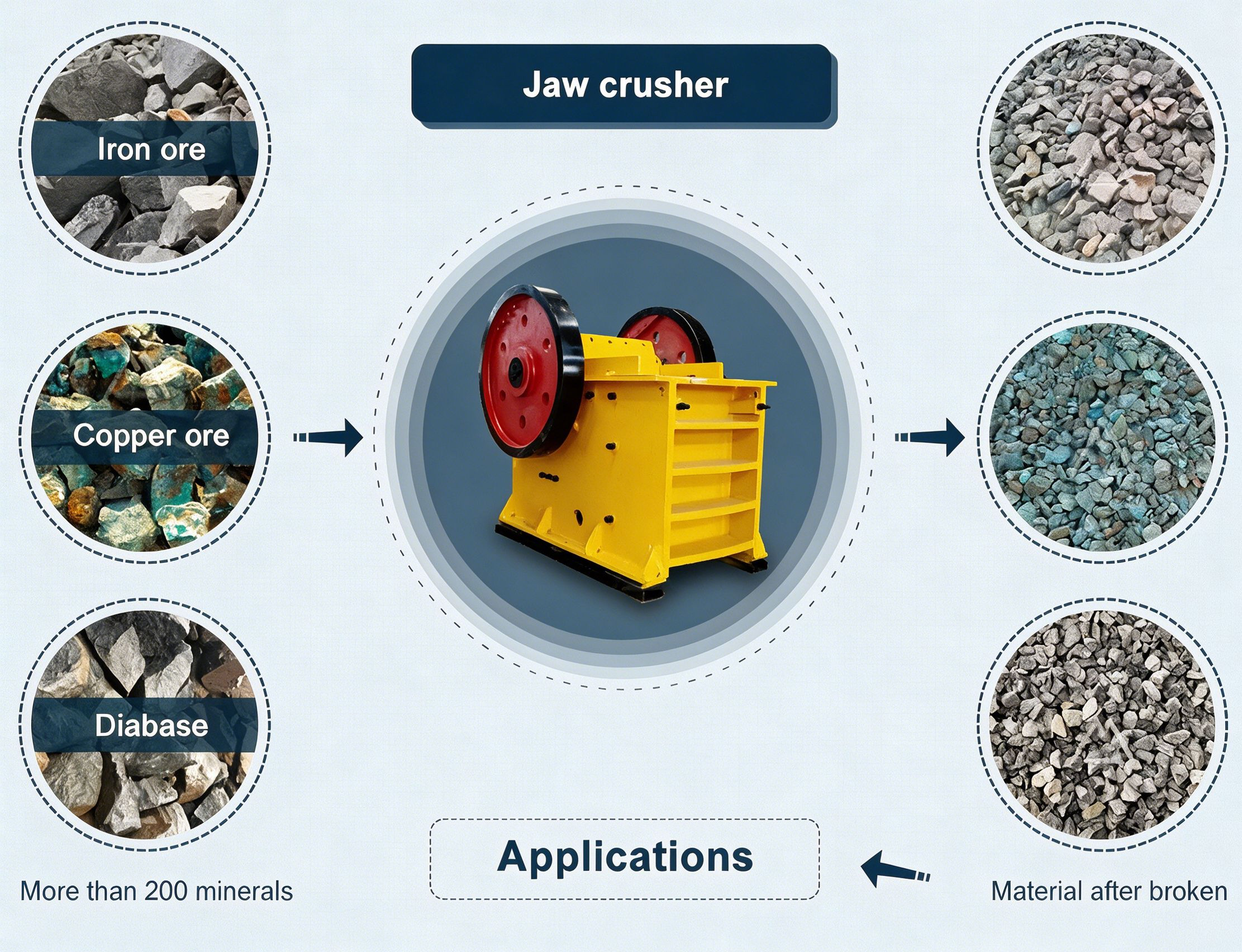
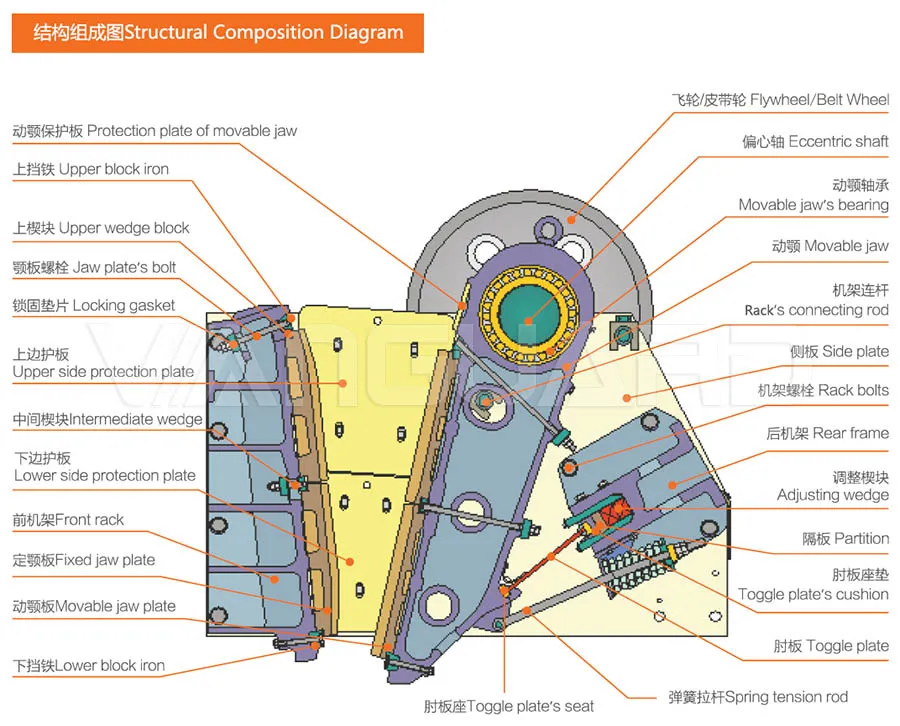
The jaw crusher is one of the oldest and most widely used crushers in the industry: two jaw plates form a V-shaped crushing chamber—one fixed, one swinging back and forth—to “bite” large rocks apart. An eccentric shaft drives a crank-rocker mechanism that moves the swing jaw in a complex planar path, squeezing, splitting, and bending the material until it is small enough to fall out by gravity. Nearly every hard-rock crushing circuit in mining, quarrying, construction-recycling, metallurgy, and building materials starts with one.
2. Working Principle: Squeeze, Split, and Bend
Each working cycle of the jaw crusher has two phases: as the swing jaw approaches the fixed jaw, the material gets crushed by compression, splitting, and impact; as the jaw retracts, crushed material discharges by gravity and fresh feed flows in.
Two geometric parameters gate the machine’s ability. First, the nip angle between the plates must stay within 19°–23°; larger angles cause “boiling,” where the plates cannot grip the rock and it slips up and down in the chamber(NERC Open Research Archive). Second, the closed-side setting (CSS): opening it raises capacity but coarsens the product. As a rule of thumb, the discharge size runs about twice the crusher setting.
3. Core Data: Feed, Capacity, and Reduction Ratio
The jaw crusher is a champion at swallowing big rocks: industrial models accept feed up to 1,200 mm, cover 20–1,000 t/h, deliver a single-stage reduction ratio of 4:1–6:1, and produce 40–200 mm material. The reduction ratio is calculated as F80/P80 (the 80% passing sizes of feed and product), and the industry regards about 6:1 as ideal(NERC Open Research Archive).
How wide is the specification gap? Consider two numbers: a compact PE-400×600 takes 340 mm feed, discharges at 40–100 mm, and handles 16–64 t/h; a giant PE-1200×1500 delivers 400–800 t/h, weighs over 70 tons, and its motor climbs from 30 kW to 250 kW. When selecting, first check the maximum feed lump—the practical limit is about 80% of the jaw gape.
4. Division of Labor with Other Crushers
The jaw crusher is not a universal machine—it works as a relay partner with cone and impact crushers. The jaw holds the primary stage, taking big feed and making mid-size material; the cone holds secondary and tertiary duty, producing cubical final aggregate. The jaw’s irreplaceability lies in this: only it can directly swallow blasted run-of-mine rock and reinforced concrete, with simple structure, cheap wear parts, and low maintenance barriers. Jaw plates typically last 500–1,500 operating hours, and skilled crews replace them in 4–8 hours.
5. Recommendation: Minjie Machinery Jaw Crushers
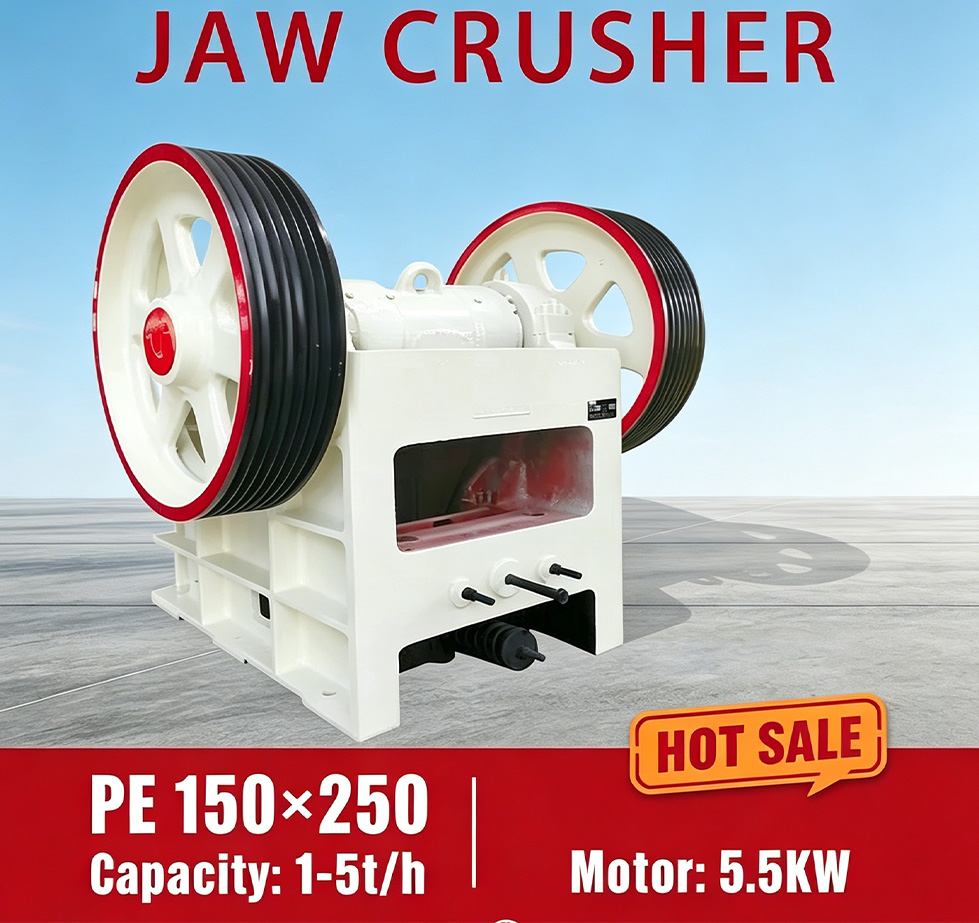
Weighing crushing force, wear resistance, and maintenance convenience, we recommend Minjie Machinery’s jaw crusher series, with four strengths:
- Deep-chamber optimization: finite-element-optimized motion trajectory lifts crushing efficiency by about 15% ;
- Heavy-duty bearings: heavy spherical roller bearings raise load capacity by 40% and double service life ;
- High-wear jaw plates: high-manganese steel with carbide inlays delivers 3× the wear resistance of standard plates ;
- Full size range: PE/PEX series from laboratory units to 1200×1500 giants, with hydraulic CSS adjustment and overload protection.
Before ordering a jaw crusher, prepare three figures: maximum feed lump, target capacity, and material hardness plus abrasiveness—then let the supplier match the model, speed, and jaw-plate material accordingly.
6. Conclusion
The jaw crusher has changed little in a century of structure, yet it remains the opening pioneer of every crushing line—it takes big feed, withstands hard rock, and repairs simply. Hold the nip angle at 19°–23°, set the reduction ratio near 6:1, and keep the jaw plates wearing well, and both output and cost fall into place. With its deep-chamber design, heavy-duty bearings, and alloy jaw plates, Minjie Machinery gives mining, quarrying, and recycling producers a reliable answer for the first crushing stage.
Contact us now for more information and product quotations.